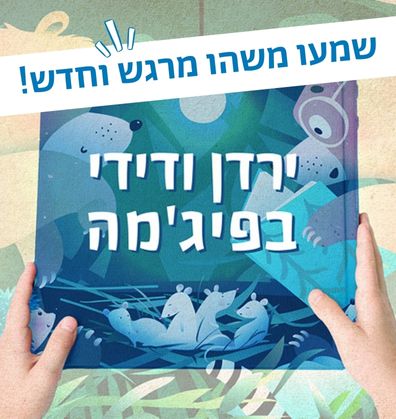
Sometimes toddlers decline the offer to have a book read to them for various reasons. How can we get them to take an interest in books? We can trigger their curiosity if we leaf through a book ourselves, and remark on details that catch our eye or amuse us. Books should be placed openly and within reach, and you should find the right time for reading, when you and your children are free to comfortably sit together.
For more ideas, look up “How to get children interested in books” on the Sifriyat Pijama website.
In your opinion, how did the boy feel when he received a cat instead of a dog? Have you ever really wanted something, but received something else instead? What can we do when we do not receive exactly what we wanted?
In this book, the boy discovers the cat’s special qualities: It hops onto your lap, licks you, its fur stands on end, and it purrs. You can observe animals in your vicinity together, and try to identify the unique qualities of each – how does it move? Which sounds does it make? And how does it respond to humans?
The boy received a surprise cat – what other surprising animals can we “bring” home? How does an alligator sit on the couch? How does a snake slither across the carpet? You can play the following game: Take turns miming an animal and have the other players guess which one you are.
This is a special book about a special family, in which one brother is visually impaired or blind. The narrating brother is well aware of the challenges in his family and the restrictions required of him at home, yet chooses to see the world in a positive light. We suggest that you, parents, read the book before reading it together to adapt the reading and discussion to this book’s unique contents.
Do you think the child in this story is lucky? Why? What makes you lucky? You can share with one another, parents and children, the good things in your shared life as a family. You can create a regular ritual during which, once a week, family members share the positive things that they experienced that past week.
How do blind children experience life? Scan the code to watch an episode of “I’m sorry for asking” about blind children. Following the video, you can discuss what makes our lives similar to or different from that of the children depicted in the video.
Rereading can reveal new and surprising things. We recommend reading the book twice, looking at the illustrations and searching for clues about Hagay’s visual disability: What about the words and illustrations hints at this family’s challenge? Did you notice it the first time you read the book?
Hagay knows how to tell made-up stories. You can try it too! How about choosing two items and using them to tell a made-up story: a brush and a rug, a bottle and a stuffed cat, a hat and a window – what can happen to them in the made-up story you will come up with together?
You may want to pause as you read and ask your child: Where do you think the cat is rushing off to? Why is Mr. Goat blocking the way? Will the vixen eat all the raspberries that she has picked herself?
Perhaps you would enjoy taking a look at the illustrations in this book together: Have you noticed Duck’s and Porcupine’s special eyebrows? Can you discern who is angry and upset, and who is happy and relaxed judging by their eyebrows alone? You may want to sit one opposite the other and take turns to cover your face, leaving nothing but your eyebrows visible. Now, pull a face – happy, surprised, angry, or sad – and ask the other to guess which emotion you were trying to express by your eyebrows alone.
You could make a finger theater using eyeliners and lipsticks: draw needles on the back of your finger, and a nose and mouth on the front – and you have got yourself a porcupine; paint the thumb and forefinger of your other hand red with some lipstick, so that their tips form a bill – and you have got yourself a duck. Use both hands to perform a show based on this book. Which hand is quick to judge? Which hand gives others the benefit of the doubt?
Perhaps you could share a story with your child about a time when, like the duck in this book, you were quick to jump to conclusions about others’ actions. When something unpleasant happens, we can try to adopt the “porcupine” approach, and repeat the phrase “maybe, possibly, perhaps” together.



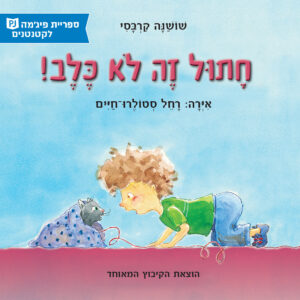 A Cat is Not a Dog!
 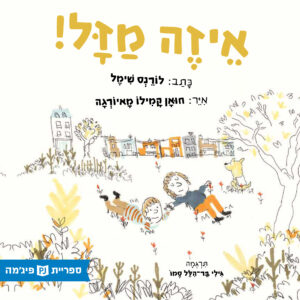 How Lucky I Am
  Maybe, Possibly, Perhaps